
The Nitrogen Cycle in the Aquarium


Aquarium Nitrogen Cycle Basics
The nitrogen cycle is important to closed aquatic ecosystems because it is the process of breaking down nitrogen waste products into less toxic, and more useable compounds. This creates a “cleaner” environment for your aquatic pets. Without the nitrogen cycle in the aquarium, waste would linger in its raw toxic forms causing irritation, infection, sickness, and death.
Table 1.1 Introductory forms of nitrogen.
Name | Symbol | Type |
nitrogen | N | Organic |
nitrogen gas | N2 | inorganic |
ammonia | NH3 | inorganic |
ammonium | NH4+ | inorganic |
The cycle begins with the introduction of nitrogen into your system by means of ammonia (NH3), ammonium (NH4 + ), nitrogen gas (N2), and organic nitrogen (N) [solid waste].
The first three forms are inorganic because the nitrogen molecule is not attached to organic material. The last form is organic nitrogen because the nitrogen molecule is attached to organic tissue like solid waste product, DNA, proteins, lipids, fats, epithelial tissue (scales/skin/plant cells), and other organic substances that are emitted from living organisms (Randall 1987).
In other words, fish excrete nitrogen from their gills (ammonia [NH3], ammonium [NH4+]), and as solid waste (nitrogen [N]) (Randall 1987).
The organic forms of nitrogen (N) and some of the inorganic forms (ammonia [NH3] and ammonium [NH4+]) introduced into the aquarium are available to plants and algae to absorb and use for growth. Other inorganic forms of nitrogen (nitrogen gas [N2]) must be further converted into a useable form (ammonia/ammonium [NH3/NH4 - ]) This is known as nitrogen fixing and is the first step of the nitrogen cycle (Bernhard 2010).

Once all the unusable forms of nitrogen have been converted to a useable form (ammonia, ammonium), they are converted again in the second step. So far the “raw” forms of nitrogen have been discussed which are introduced into the aquarium by simply adding fish (ammonia, ammonium, nitrogen) and plants (nitrogen), or by having the water in your aquarium exposed to the air (nitrogen gas).
Table 1.2 Sources of introductory forms of nitrogen.
Name | Symbol | Type | Form |
nitrogen | N | organic | solid waste, organic tissue (cells), proteins, fats |
nitrogen gas | N2 | inorganic | atmosphere |
ammonia | NH3 | inorganic | excreted through fish gill urea |
ammonium | NH4+ | inorganic | excreted through fish gills, urea |
After nitrogen fixing (nitrogen gas [N2] and organic nitrogen [N] is converted to ammonia/ammonium), only ammonia [NH3] and ammonium [NH4+] remain. The process of turning ammonia and ammonium compounds into less toxic nitrite (NO2) and then even less toxic nitrate (NO3), is known as nitrification (Bernhard 2010).
This is the second step of the nitrogen cycle. This step is accomplished with the help of nitrifying bacteria (discussed below).
In nature, the third and final step of the nitrogen cycle is the removal of oxygen atoms from nitrite and nitrate as it is absorbed by plants, or returned to the atmosphere in the form of nitrogen gas (Bernhard 2010). In the aquarium, we can see this process carried out on a much smaller scale.
If the aquarium does not have enough plants, or enough absorptive media to absorb nitrate (NO3) and break it down into nitrogen (N), the nitrate will build up and become toxic. This buildup of nitrate is why most aquarists choose to do water changes, which removes nitrate contaminated water and replaces it with “cleaner” water.
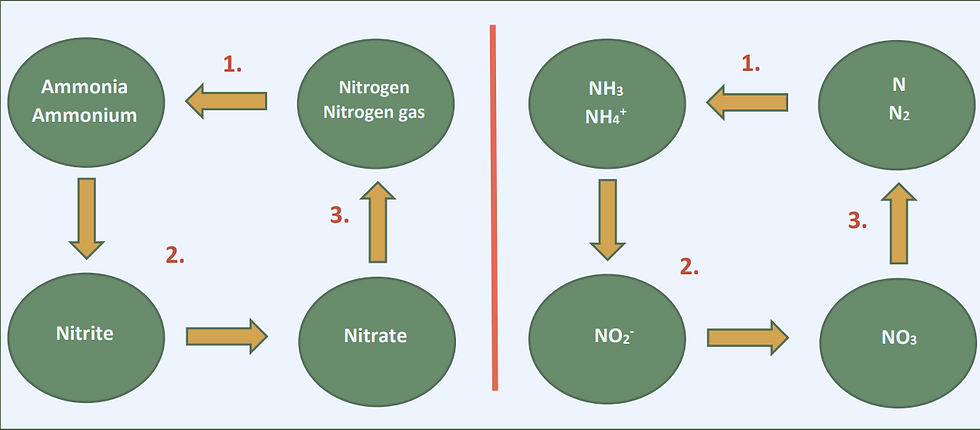
This is the basis of the nitrogen cycle. Next, is how this process plays out in setting up a new aquarium.
Cycling the Aquarium
Cycling an aquarium can be a long process, but if done carefully, it can be accomplished while simultaneously enjoying the life in the new aquarium. In this section, introducing nitrogen into the system, which will initiate the nitrogen cycle, will be discussed, as well as (1) fishless cycling, (2) natural cycling, and (3) seeded cycling. Cycling the aquarium is also commonly referred to as “establishing” the tank.
Before getting into the different methods of cycling, it is important to understand how to set up the aquarium’s biological filtration for success. This creates the most optimal habitat for helpful nitrifying bacteria to grow.
Nitrifying Bacteria
There are several species of bacteria that aid in nitrification. Nitrosomonas and Nitrobacter are the two most common genera, or types, which live in the freshwater aquarium (Gee 1990). Nitrosocystis oceanus is the main nitrifying bacterium species in marine systems (Murray 1965). These bacteria exist in drinking water, in garden soil, even on wet rocks, and in the atmosphere.
When an aquarium is set up, even if nothing is added to it, eventually these species of nitrifying bacteria will find their way into the water column and begin nitrifying ammonia/ammonium (NH3/NH4+) into nitrite (NO2) and then into nitrate (NO3). It is very difficult to keep these bacteria out of the aquarium.

In the aquarium, these bacteria live on every surface, in and on the substrate, and the filter media, even the aquarium glass. Those materials in the aquarium with the most surface area will have the most bacteria living on them. For example, a solid piece of gravel has as much surface area as you can see on the outside.
A specialized piece of biological filtration media, unlike gravel, is very porous and has millions of tiny little spaces inside of each piece which are all exposed to the water column. This increases the surface area of the piece of specialized media by up to thousands of times of the surface area of a similar sized piece of gravel. When the filter is filled with specialized media, an enormous habitat for helpful nitrifying bacteria to grow is created. The more bacteria, the more nitrogen they can convert. This habitat is referred to as the biological filtration.
Fishless Cycling
Fishless cycling refers to the process of setting up the biological filtration and then adding inorganic or organic sources of nitrogen, mostly in the form of pure liquid ammonia, fish food, or plant matter. It is not recommended to use fish food as the exact amount of ammonia being added cannot be controlled. When using fish food or plant matter, the decaying material releases a lot more than just nitrogen. Fish food has many filler ingredients as well as proteins, lipids, fats and other non-water-soluble compounds.
Using liquid ammonia can be very precise; however, liquid ammonia can be dangerous, and should only be handled according to directions.
Regardless of the method used to add it, ammonia is fed upon by nitrifying bacteria, converting it to nitrite, then to nitrate. During this process do not add any living invertebrates or fish to the aquarium, because the advantage of this method is it allows you to add excess ammonia to speed up the process.
According to a study conducted in 2009, up to 9 ppm (parts per million) of ammonia can be added when fishless cycling and the Nitrosomonas bacteria will nitrify it at a normal rate.
Fishless cycling can be the fastest method, but it is very toxic and the ammonia must be handled with caution. Once ammonia tests positive in the tank the process continues identical to the other methods of cycling described below.
Natural Cycling

Natural cycling is the method most used as it allows for the addition of livestock right away. However, only a very small number of living specimens can be added at one time. This method takes longer, but inhabitants can be added to the new aquarium after 24 hours.
There is no set rule for how many fish can be added right away. The biological filtration needs to be set up, and only 5% to 20% of the total specimens should be added at a time. This percentage should include invertebrates as they also produce waste.
For example, if you have a new 30 gallon tank, and you want a school of 20 small tetras when all is said and done, you will start with about five. Or if you have an 80-gallon aquarium and you want to end up with two schools of around 20 fish and a pair of cichlids, you should start with 5 fish of each schooling species. The cichlids need to be introduced last, as they can be less hardy, and sometimes more aggressive depending on species. Also, only add a species to an aquarium in which it will live out its whole life.
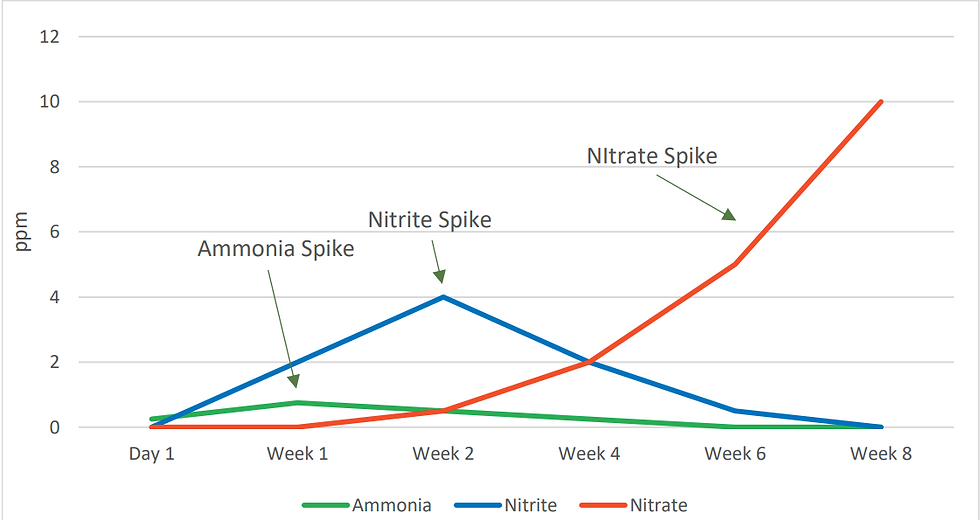
Do not add an aggressive species to a tank just because it is hardy and then remove it later. After initial fish have been added, check the free and total ammonia (ammonia/ammonium) levels. These should rise to .25 or .5 ppm over several days.
Next, there will be a spike in the nitrite test levels as the bacteria converts the ammonia and ammonium. Finally, a spike in nitrate, with 0 ppm of ammonia/ammonium and 0 ppm of nitrite, signifies that there is an appropriate amount of bacteria in the tank to handle the amount of ammonia/ammonium being produced by the fish and invertebrates. At this point more fish can added, which will increase the rate of ammonia/ammonium production, and therefore will also increase the amount of bacteria in the aquarium.
Once there is a spike in nitrates, along with 0ppm of ammonia/ammonium and nitrites, the tank is cycled. Be careful not to add too many fish at once. Every time there is an increase in the rate of ammonia production (by adding fish), the tank will go through another mini-cycle. While there should be a consistent source of nitrogen in the form of ammonia/ammonium for the bacteria to establish, it should not be overdone.
One of the easiest mistakes to make while naturally cycling is to add too much fish food. For omnivorous and carnivorous species, feed only every other day until ammonia tests zero, then feed normally. For herbivorous or grazing species feed only once per day while ammonia is present, then feed as directed. Make sure to remove all excess uneaten food after five minutes with a net or pipette.

Plants are an effective addition to the aquarium at any time. By adding live plants along with CO2, nitrogen, phosphorus, potassium, iron and trace elements, a more realistic ecosystem can be established. Plants will only benefit the growth of helpful bacteria, including nitrifying bacteria. Only add plants that will do well in the aquarium, as massive die off of leaves and other tissues can result in ammonia spikes which can prove detrimental to fish and invertebrates.
Natural cycling is the least recommended form of cycling on its own because it involves exposing living specimens to some amount of nitrogen in its more toxic forms. When you seed bacteria to the tank during natural cycling it can prevent the more toxic spikes in nitrogen compounds.
Seeded Cycling
Seeded Cycling is not an entirely separate cycling method, but rather an addition to the methods previously discussed. Seeding the tank will hasten cycling and ensure a safer process for the fish. Initially, the biological filtration can be seeded by adding gravel or filter media (preferably porous filter media) from a cycled aquarium to the new tank.
This introduces a population of bacteria which will start fixing ammonia/ammonium as soon as it is introduced. Be careful not to add media from a tank that has a known bacterial, fungal or parasitic infection.
Once an established population of nitrifying bacteria have been introduced, the aquarium can continue to be seeded throughout the cycling process with additional bacteria, either from media taken out of an established tank, or from off-the-shelf products containing nitrifying bacteria. Use caution when purchasing these items, if the bacteria are inert or decaying, they will only increase the ammonia levels. It may be best to seed from a healthy established tank and have patience.
Table 1.3 Approximate ideal levels during cycling process
Pre-Cycle
Ammonia | Nitrite | Nitrate | |
Day 0 | 0 ppm | 0 ppm | 0 ppm |
Day 1 | <0.25 ppm | 0 ppm | 0 ppm |
Mid-Cycle
Ammonia | Nitrite | Nitrate | |
Weeks 2-6 | 0.5 ppm | <0.5 ppm | 0 ppm |
0.25 ppm | 0.5 - 5 ppm | < 5ppm | |
>0.25 ppm | >0.5 ppm | <10 ppm |
Post-Cycle
Ammonia | Nitrite | Nitrate | |
Weeks 4-8 | 0 ppm | 0 ppm | <20 ppm |
Cycling FAQ
➢How many fish can I add at first?
There are some general rules of thumb out there, but it is best not to follow them too strictly due to the sheer number of variables at play. Instead, I recommend knowing the different variables of your tank and making a decision from there.
Variables include tank size, amount of biological filter media, amount of nitrifying bacteria already present or pre-seeded, the type of fish you want in the tank, desired invertebrates and so on. Always err on the side of caution and add fewer specimens if you are unsure. Regardless, only add known hardy species initially. You never want to add an expensive, fragile species when the tank chemistry is volatile.
If you only want that one species in the tank, try fishless cycling.
➢ What is the best way to test?
If you’re unfamiliar with testing, the best way is to have a professional take care of it for you. If you would like to do your own testing you will need a test kit for ammonia, nitrite, and nitrate. Test for ammonia every day until you start to see 0.25 to 0.5 ppm. Then test for nitrate and ammonia every day until you see 0.5 to 1 ppm nitrite. Then start testing every day for ammonia, nitrite and nitrate. You can stop testing for ammonia and nitrite when they go back down to 0 ppm and continue to test for nitrate. Once you see 0 ppm ammonia and nitrite, and at least 5 ppm of nitrate, your tank is cycled. The nitrate will not leave your system without the aid of a water change, specialized filter media, certain anaerobic bacteria, or photosynthetic organisms (plants and algae).
Expect the nitrate level to continue to rise until you remove it with one of these methods. Be sure to limit nitrate levels to below 20 ppm for most setups and 10 to 20 ppm for sensitive fish and corals.
Literature Cited
Bernhard, A. The Nitrogen Cycle: Processes, Players, and Human Impact. Nature Education Knowledge 3(10):25. 2010.
Gee, CS., Pfeffer, JT., Suidan, MT. Nitrosomonas and Nitrobacter Interactions in Biological Nitrification. Journal of Environmental Engineering. 116:1. 1990.
Murray, RGE., Watson, SW. Structure of Nitrosocystis oceanus and comparison with Nitrosomonas and Nitrobacter. Journal of Bacteriology. 89:1594-1609. 1965.
Randall, David J., Wright, Patricia A. Ammonia distribution and excretion in fish. Fish Physiology and Biochemistry. 3; 107-120. 1987.
Photos
Fig. 1.3 https://www.cermedia.com/marinepure/
Fig. 1.4 Boodleshire LLC 2021
Fig. 1.5 Boodleshire LLC 2021


Comments