
Aquariums as Biophilic Design


We are products of our environment and that environment is mostly artificial. We spend an overwhelming amount of time inside. There is not much we can do about it other than try and spend some of our free time outside.
Another option is to bring the outside inside. The Biophilia Hypothesis suggests that humans have an innate connection to nature and therefore benefit from its proximity, especially in an artificial environment (Wilson 1984).
The Science & Philosophy of Biophilic Design
Biophilic design is a nature-centric philosophy, advocating for the proximity to nature as a healing and restorative fixture. The philosophy of biophilic design promotes the use of natural systems integrated into the design of a built environment. (Kellert, 2008).

Humans evolved in nature for hundreds of thousands of years. Our brains are developed to understand but not be overwhelmed by the natural systems that surround us.
In a chaotic, artificial environment, we can become overstimulated.
Expanding on the Biophilia Hypothesis, the Attention Restoration and Stress Recovery theories posit that natural restorative environments facilitate positive moods and draw attention without being stressful or demanding. These types of environments can help people recover more quickly and fully from mental fatigue and stress (Kaplan & Kaplan, 1989; Joye, 2012; Gifford & McGuinn 2012).
All this is to say, nature calms and relaxes us physically and mentally, so why not take advantage of that everywhere we are. Especially if it is as simple as bringing in a few houseplants.
There are three decades of research that supports this theory of natural light, water, plants and ecosystems being restorative physically and mentally (Gillis & Gatersleben 2015).
Biophilic design is therefore best practiced with multi-sensory natural stimuli. Combining sound, touch, smell, and visuals are particularly effective at restoring us (Alvarsson et. al. 2010).
Biophilic Design in Built Environments
Biophilic Design is a widely recognized and well used concept in today's architecture. The benefits of biophilic design are well regarded and even regulated by several agencies and programs around the world.
There are three primary organizations that incorporate biophilic design into their best practices and regulate certification for using biophilic design internationally.
International WELL Building Institute (IWIBI)
International Living Future Institute (ILFI)
US Green Building Council (US GBC)
The IWBI recognizes biophilic design through the WELL Building Standard, a program that facilitates green architecture (WIBI, 2025).
The ILFI offers the Living Building Challenge as a way to foster sustainable and green design into new construction (ILFI, 2025).
The US GBC regulates the strict LEED Certification program, a title that comes with the knowledge the receiver has done their best to incorporate renewable and green technology into their design. The LEED Certification also includes a biophilic design element, recognizing the restorative benefits (USGBS, 2025).
Biophilic Design in Kansas City
Biophilic design is not just a theoretical concept. There are real world examples all around us. Where I live, in Kansas City, the art museum, The Nelson-Atkins Museum of Art, is proposing an addition onto their campus.
The winning design heavily incorporates biophilic design, both inside and outside.

The Waterfall at the Westin in Crown Center is a grand installation with many sources of natural stimulus including sight, sound, and smell.

Serendipity Labs is a coworking space in Overland Park that utilizes a living moss wall to bring nature inside.

Integrity Truck Sales in Prairie Village has a planted aquarium in their sales office. Their employees have commented frequently on the aquarium's ability to help them reset and relax after a challenging sales call or a long day.
Benefits of Biophilic Design: Psychological & Physiological
In 2021 a literature review of the past 30 years of research on biophilic design was conducted and published in the Journal of People Plants Environment. The following lists of psychological and physiological benefits of biophilic design were each supported in at least five independent papers.
This means at least five studies, independent of each other, found the following benefits of biophilic design to be statistically significant (Hung & Chang, 2021).
Psychological Benefits of Biophilic Design
Promotes attention restoration
Is appealing
Is preferable over lack of natural elements
Positively impacts emotions & mood
Induces tranquility
Promotes relaxed and restored feelings
Lowers sense of fear & perceived fear
Lowers aggression
Lowers anxiety & stress
Lowers tension
Lowers depression & sadness
Increases overall happiness
Increases pleasure, familiarity, fascination, and compatibility
Improves mental engagement
Positively impacts cognitive performance
Increases productivity
Enhances creativity
Improves communication
Improves concentration
Decreases sleepiness
Decreases sick leave
Increases overall satisfaction
Increases self-esteem
Increases self-confidence
Physiological benefits of Biophilic Design
Lowers diastolic blood pressure
Lowers systolic blood pressure
Lowers heart rate
Increases standard deviation of the R-R intervals (indicator of heart health)
Lowers frontalis muscle tension (responsible for tension headaches)
Reduces skin conductance level (an indicator of stress)
Increases overall energy
Increases overall perceived physical health
Lowers cortisol levels (a direct cause of stress)
Increases oxyhaemoglobin (blood oxygen levels)
Benefits of Biophilic Design: Financial
All of these benefits, both psychological and physiological, can help us in our every day lives including at our homes.
They can also help us as employees and co-workers where we spend a good portion of our time; work.
The consequences of a restored and relaxed workforce have financial implications. Biophilic design in the workplace can help with employee retention, attentiveness, satisfaction, health, and even lowering the bottom line.
In some businesses, employee salaries and benefits can account for upwards of 90% of costs and employee turnover costs between 150% and 250% of an employee’s annual salary.
Any action taken to reduce those costs by any percentage would have a significant and positive impact on the bottom line (Alker et. al., 2015) (Bliss, 2015).

Biophilic design, for the reasons listed above, helps increase employee satisfaction and output while reducing costs.
Absenteeism (sick days) account for 4% of unproductive staff costs, which equals, on average, $2,502 annually per employee (Browning et. al., 2015)
Presenteeism (reduced productivity) accounts for 1.5% of unproductive staff costs, which equals $1,250 annually per employee (Browning et. al. 2015).
When a workplace incorporates a natural, restorative design into their space, these figures drop significantly by restoring mental and physical health, leading to less sick days and higher mental engagement and cognitive function (Hung & Chang, 2021) (Browning et. al., 2015).
In a survey conducted by Green Plants for Green Buildings in 2015, 33% of 7,600 workers surveyed in 16 countries reported the design of an office affects their decision to work at a certain company. Imagine the savings of reducing the cost of employee turnover by even a fraction of 33%.
The Benefits of Aquariums as Biophilic Design
Aquariums can be designed to incorporate many different aspects of nature. They can mimic green meadows, steaming jungles, or crisp ocean reefs. In addition, aquariums stimulate multiple senses and have shown to pull attention to an otherwise disengaged audience (Windhager et. al., 2011).
Their versatility as design elements, their multisensory calming nature, and their ability to pull focus without being distracting makes them perfect biophilic design elements.

A paper published in Landscape and Urban Planning in 2011 demonstrated the placement of even a small aquarium in a mall shopping center had a significant implant on the shoppers. Compared to before the aquarium was placed, shoppers would stop, gesture to, and even converse over the aquarium (Windhager et. al., 2011).
Aquariums have the ability to draw attention in a calming and restorative manner, the heart of Wilson's original theory on biophilic design.
A study conducted in the UK in 2020 revealed that looking into a planted aquarium for 10 minutes led to an average drop in blood pressure by 15.6% and an average drop in heart rate by 3% (Gordon-Beckford, 2020).

Even some of the most influential companies in the world understand the benefits of aquariums as biophilic design.
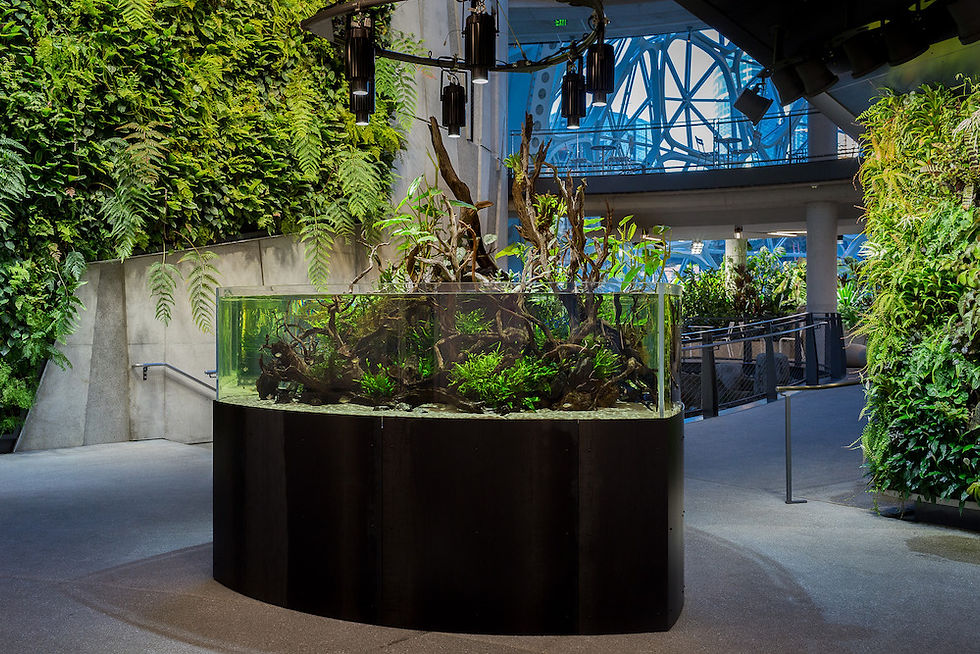
In their downtown Seattle headquarters, Amazon commissioned the design and installation of a 550 gallon, 18 foot, high-tech planted aquarium in their lobby.
Even a megacorporation, mainly concerned with their financials, understands how an aquarium can set the mood and create a calming environment, regardless of your particular motivations (Waldron, 2023).
Bring Biophilic Design Into Your Life.
As I’ve demonstrated, biophilic design has a multitude of proven benefits and aquariums are an ideal version of biophilic design.
Whatever form of biophilic design you prefer, please incorporate biophilia into your life in some manner. You don’t even have to take care of house plants or install an aquarium.
Take a walk in a nearby forested trail, a prairie reserve, local park, or even stop into your local fish store and just stand in front of their display for 10 minutes. I promise you they won’t mind, in fact, they’ll probably stand there with you.
Literature Cited
Alker, John, Michelle Malanca, Rachel O'Brien, and Chris Pottage. Health, Wellbeing & Productivity in Offices The next Chapter for Green Building. Rep. World Green Building Council, Sept. 2014. Web. Aug. 2015.
Alvarsson, J.J.; Wiens, S.; Nilsson, M.E. Stress recovery during exposure to nature sound and environmental noise. Int. J. Environ. Res. Public Health 2010, 7, 1036–1046.
Bliss, Bill. "Bliss & Associates Inc. -- The Business Cost and Impact of Employee Turnover." The Business Cost and Impact of Employee Turnover. Bliss & Associates Inc., 2008. Web. Sept. 2015.
Browning, Bill, Chris Garvin, Bob Fox, Rick Cook, Leslie Labruto, Namita Kallianpurkar, Catie Ryan, Siobhan Watson, and Travis Knop. The Economics of Biophilia. Rep. Terrapin Bright Green LLC, 2012. Web. June 2015.
Gifford, R.; McGunn, L.J. Appraisals of built environments and approaches to building design that pomote well-benig and healthy behavior. In Environmental Psychology: An Introduction; Steg, L., van den Berg, A.E., de Groot, J.I.M., Eds., Wiley: Hoboken, NJ, USA, 2012.
Gillis, K.: Gatersleben, B. A Review of Psychological Literature on the Health and Wellbeing Benefits of Biophilic Design; Buildings 2015, 5, 958-963.
Gordon-Beckford, Akil. 2020. The Therapeutic Effect of an Aquarium in the Workplace. Videreaquariums.com.
Hung S.; Chang C.; Health benefits of evidence-based biophilic-designed environments: A review. J. People Plants Environ. 24(1): 2021.
Joye, Y.; van den Berg, A.E. Restorative environments. In Environmental Psychology: An Introduction; Steg, L., van den Berg, A.E., de Groot, J.I.M., Eds.; Wiley: Hoboken, NJ, USA, 2012.
Kaplan, R.; Kaplan, S. The Experience of Nature: A Psychological Perspective; Cambridge University Press: Cambridge, UK, 1989.
Kellert, S.R. Dimensions, Elements, and Attributes of Biophilic Design. In Biophilic Design: The Theory, Science, and Practice of Bringing Buildings to Life; Heerwagen, J., Mador, M., Eds.; Wiley: Hoboken, NJ, USA, 2008.
Living Building ChallengeSM 3.0: A Visionary Path to a Regenerative Future. Available online: https://living-future.org/sites/default/files/reports/FINAL%20LBC%203_0_WebOptimized_low.pdf (accessed on 5 August 2015).
The Global Impact of Biophilic Design in the Workplace. Rep. Human Spaces, 2015. Web. July 2015.
Waldron, S. 2023. Creating a Biophilic Aquascape at Amazon HQ in Seattle. Tropical Fish Hobbyist: Nov/Dec 2023.
WELL Building Standard Resources. Available online: http://www.wellcertified.com/standard (accessed on 5 August 2015).
Wilson, E.O. Biophilia; Harvard University Press: Cambridge, MS, USA, 1984.
Windhager, S., Atzwanger, K., Bookstein, F., Schaefer: 2011. Fish in a mall aquarium - An ethological investigation of biophilia. Landscape and urban Planning 99; 23-30.


Comments